Jekyll2026-11-11T11:32:11+00:00https://monodot.co.uk/feed.xmlTom DonohueTom Donohue's blog. Staff Field Engineer at Grafana Labs, writing about observability and building small, useful apps.
Tom DonohueUnexpected item in bagging area2026-11-01T00:00:00+00:002026-11-01T00:00:00+00:00https://monodot.co.uk/unexpected-item-in-bagging-areaThis weekend, I wanted to do a little bit of work on one of my pet projects, apoll.app.
I wanted to get Claude to refresh the design, and lay the groundwork for some new features. It was a Saturday and I had the whole day ahead of me.
But I realised that I had run out of milk for cereal. Nothing can happen before cereal.
I figured I would start Claude on the task anyway, while I succumbed to my hunger. I stood up from my desk, headed out into the real world and walked to the supermarket, a short distance away.
While I was out, Claude sent a message to my phone with a request for clarification.
“Do you want the URL to be /new/question or /new/qa?”
I opened my phone, responded to the request with a tap, and carried on with my shopping. As I approached the queue for the self-checkouts, it buzzed again:
“Which of these styles suits your preference? Swiss/modernist, minimal/tech, functional…“1
It follows
Isn’t this all just a bit… weird?
With a £20 subscription, I have a sidekick, available 24x7. It wants to help with everything.
Stepping away from your computer used to mean terminating all work in-flight. You could always kick off a long build and walk away. A build could never tap you on the shoulder in the checkout queue.
But now, your sidekick can follow you around – in the supermarket, on the train, or even at the pub.
Now, admittedly, I choose to install the Claude app, I choose to enable notifications and I choose to respond to them. But that dopamine hit of completing a task is somewhat difficult to resist.
I’m not sure yet if having a persistent sidekick is a gift for human productivity, or if it’s just another leash. Jevons paradox seems to be happening not in a factory in the 1800s, but in my pocket. The easier the work becomes, the more of it I willingly end up doing.
Meanwhile, as Claude was churning away at the next task, I was having to balance a bottle of milk, a newspaper and several other items on those miniature self-checkout scales. Not sure Claude can handle that task, yet.
I chose the ‘Swiss/modernist’ style, by the way. Very nice. ↩
]]>Tom DonohueMaking editing static sites easier2024-11-02T00:00:00+00:002024-11-02T00:00:00+00:00https://monodot.co.uk/static-sites-pages-cmsRecently I’ve been trying to drum up the enthusiasm for tidying up and overhauling my current heap of staticsites.
I don’t update these websites very often. They usually start out with a bang and a flurry of activity. But some of them haven’t been updated in over 2 years.
Why haven’t I updated them? It might be because they are static websites. This method of building blogs comes with some serious technical baggage. It’s not for the faint-hearted. Static sites usually need to be updated with a code editor, and then the changes pushed up to a Git repository.
That’s fine when I’m learning new things. I can spend all day learning something new.
But once the site is set up, and when I spend all day in a code editor at work, the thought of spending even more time in a code editor to produce my “creative output” feels like a bit of a slog.
So this week, I wondered: should I install a full CMS like Ghost on these sites? Would that make the writing and editing process easier?
And so, I went into the weeds of how to deploy Ghost. I discovered a tool called Coolify which gives one-click deployment of Ghost onto a VPS. Neat, I thought. So I spun up a VPS in Hetzner, I tried it out, and thought Ghost felt OK. The sites look great, and the experience is pretty cool.
But I was still pretty unimpressed with the post editor. It looked fancy and all, but it’s not suitable for blogs that talk about code, at all. It’s clearly designed for proper writers.
So, clicking around Hacker News, as I usually do when looking for a bit of inspiration from my peers, I stumbled upon Pages CMS. Pages CMS is an open source, web-based content editor for static sites, just like this one. This site is built with Jekyll, but Pages CMS also supports Next.js, Astro, Hugo and others.
I’m really impressed with it so far. It was incredibly easy it was to set up, and I really like the fact that I can self-host it, if I wish.
I’m going to install it on some of my other sites and see how easy it is to get the writing bug back again.
And who knows, maybe you might see more blog posts here soon!
]]>Tom DonohueFacebook/WhatsApp: Consumers have no choice2021-01-08T10:00:00+00:002021-01-08T10:00:00+00:00https://monodot.co.uk/facebook-whatsappFacebook is making another grab for my data, this time through WhatsApp.
The valuable data in my phone book, my connections, location, social interactions and more, are all ripe for the taking.
I can either give Facebook permission to do this, or I can decline, and stop using the app.
If I decline, I’ll be locked out of conversations with friends and family, some conversations stretching back many years.
Some people suggest moving to a privacy-focused messaging app, like Signal.
The problem is: I now have to convince all of my friends to do the same.
My friends don’t share all the same views as me. (This is a good thing.)
But if I have personal concerns about privacy, and I still want to keep in contact with friends and family, I have no choice but to use these apps.
I have caved in, and accepted the new terms of service.
The market, given free rein, has failed.
Online communication tools are not a choice any more. They are a utility, used by billions, and need to be treated as such.
Telephony is regulated. I have the choice to move my phone number between providers. I can phone any other phone number, even if it’s on a different network.
So why aren’t the same freedoms guaranteed with online communications?
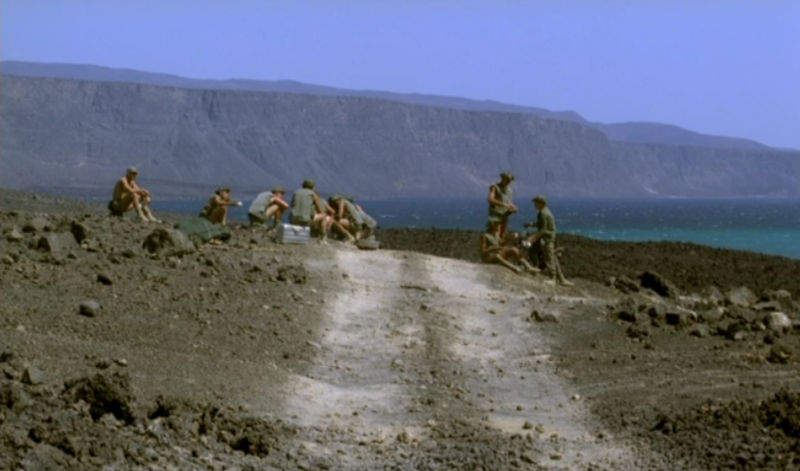
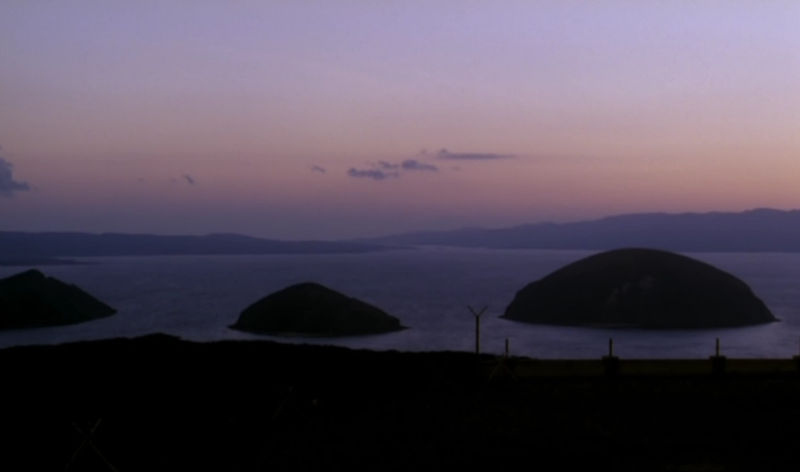
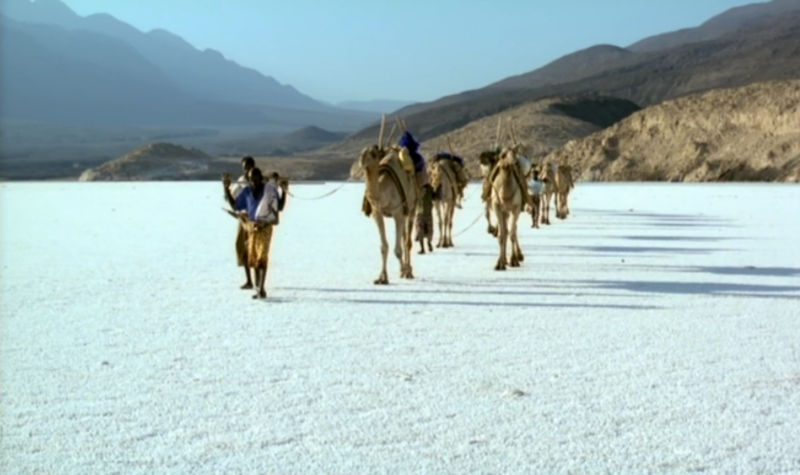
]]>Tom DonohueBeau Travail / Djibouti2019-06-30T10:00:00+00:002019-06-30T10:00:00+00:00https://monodot.co.uk/beau-travail-djiboutiI don’t really have much of a desire to join the French Foreign Legion.
But after watching Clare Denis’s film Beau Travail, I might add Djibouti to my bucket list.
I don’t know anything about the country, but the movie was filmed on location there, and there are some great shots of the country. This part of the country looks pretty bleak, at least:
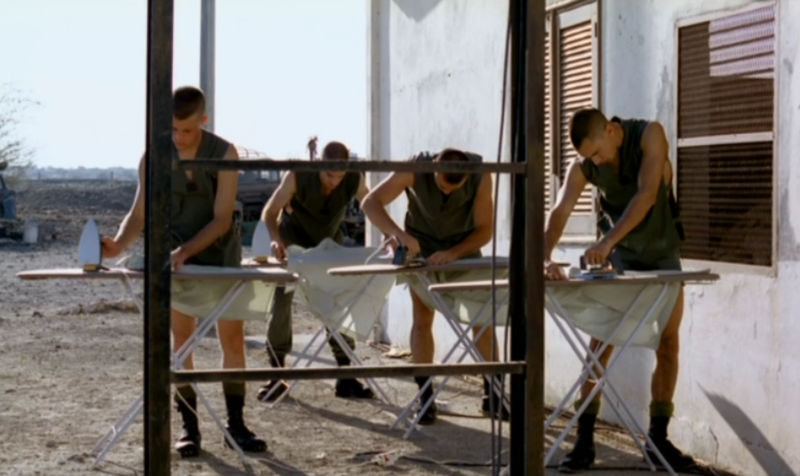
And some extreme ironing:
I do like getting to watch very obscure films on Mubi. Stuff I would never normally know about, or hunt down. Glad I made the effort with this one.
]]>Tom DonohueGoogle’s lost my blog2019-06-12T10:00:00+00:002019-06-12T10:00:00+00:00https://monodot.co.uk/google-wheres-my-siteLast month I moved my main developer blog from cleverbuilder.com to tomd.xyz. And somehow I seem to have lost most of my traffic. Oops.
I decided to move URL, because I want to give my developer blog a more personal feel.
I want to give my blog a simple identity that bears more relation to me as the author, rather than some random brand, Clever Builder, which sounded a bit corporate and doesn’t really reflect where I am in 2019.
What a disaster so far. In Google Search Console, my site’s search appearances and clicks have plummeted. Overnight, my visitors went from about 600 per day, to almost zero.
I went through Google’s recommended actions in the event of a traffic drop. I feared that maybe I’d been penalised for switching URLs. But I don’t think I’ve done anything wrong, and there are no manual actions listed inside Search Console.
So I’m stumped. This has been continuing for about two weeks.
At the moment I’m not sure what to do, but I’ll wait a couple of weeks more, to see if it’s just a blip.
Thank god this isn’t how I make a living! This has made me realise that being solely at the mercy of Google for your traffic (and income) must be a very precarious place to be.
Fingers crossed I get my lovely visitors back soon…
]]>Tom DonohueQuarterly Review: 2018 Q42019-01-20T10:00:00+00:002019-01-20T10:00:00+00:00https://monodot.co.uk/review-2018-q4Here’s my final quarterly review of 2018, and a quick look at 2019.
If you’re eagle-eyed, you’ll notice that there wasn’t a Q3 review. I’ll explain why later.
Camel Step-by-Step - a book I’ve been writing, on Apache Camel for beginners.
Flat Haus - a small home decor website and Instagram account - I’m not doing much with this site at the moment, as I don’t have the time.
Clever Builder
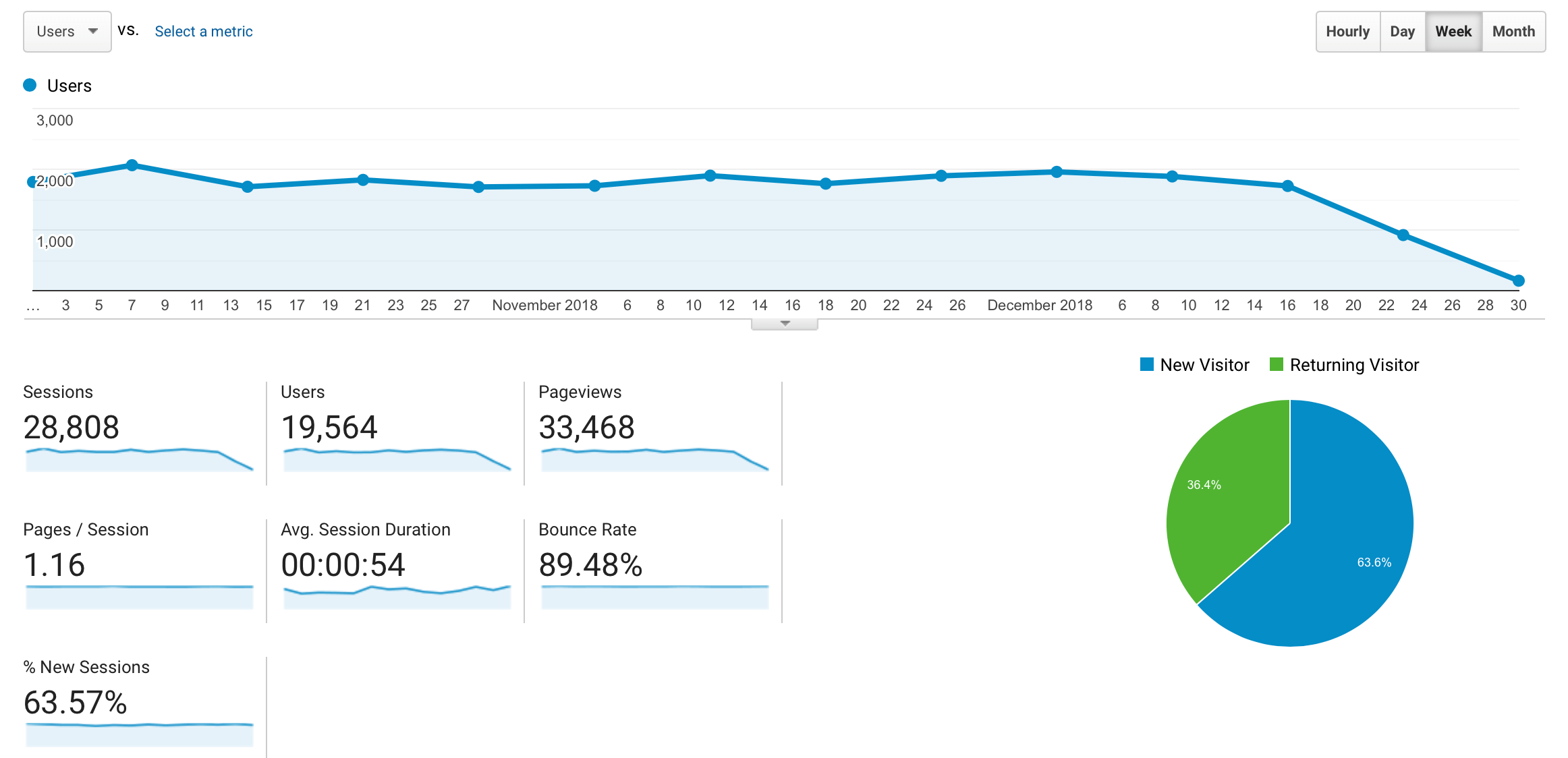
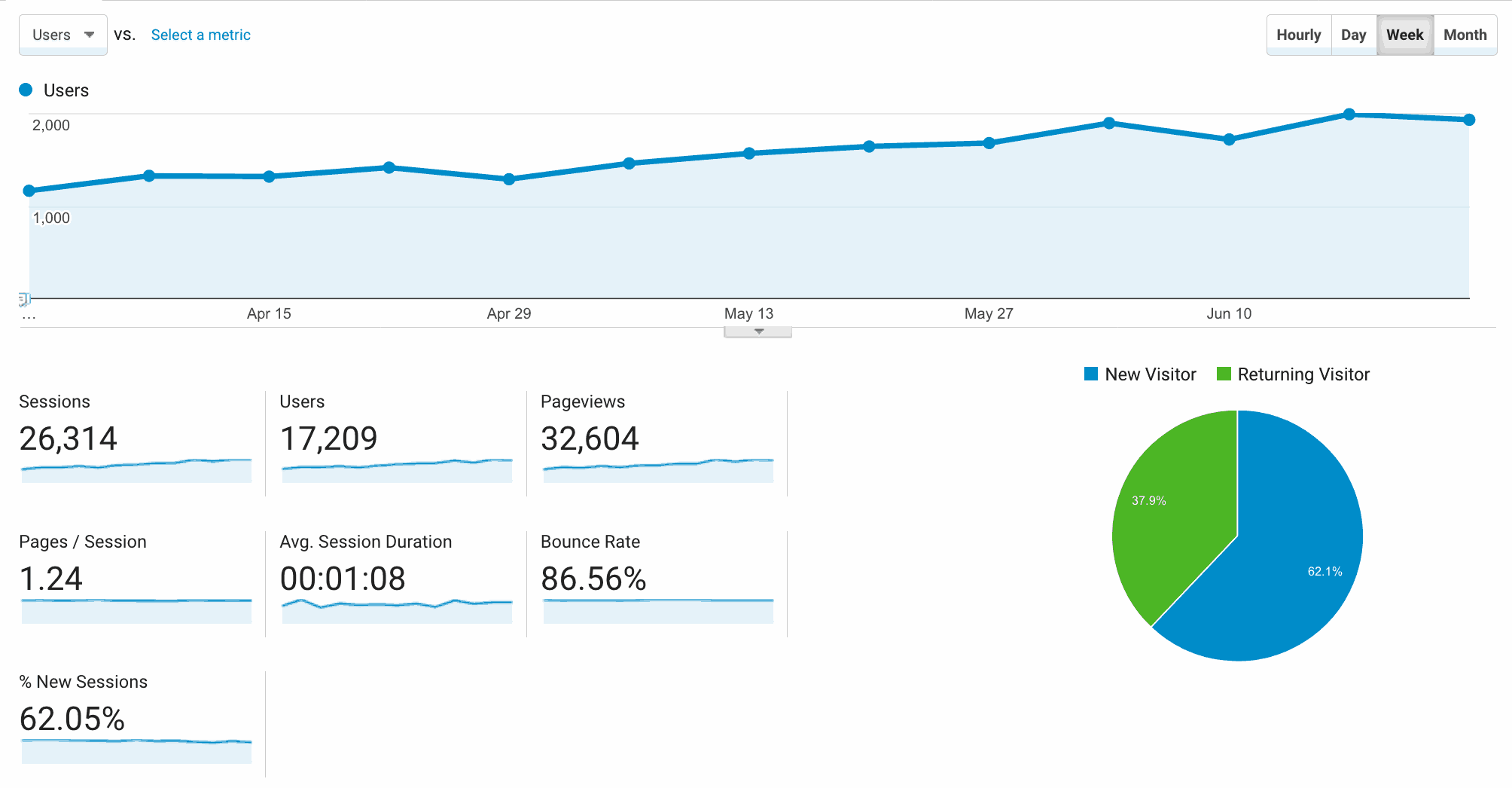
User numbers for Clever Builder rose to 19,564 - not much of an increase, but that’s because I didn’t really add any major new content to the site, and didn’t improve existing content either:
This quarter, I wrote one new article. Yes, just one article:
This one article was just a quick braindump of things I found out when I went to see a customer.
Other than that, I found it really hard to find any time to update the website.
Thoughts
Having no time
I was pretty busy in the second half of this year. Work got busier, and with more travelling involved.
I had a few weekend breaks with some amazing friends.
As a result of both, I was flying almost every week.
That used up a lot of my energy, and I felt I had less drive to write articles, or even work on the book.
If I’m spending all week travelling and working intensely on a computer, I just don’t want to stare at a laptop screen on Saturdays and Sundays.
I managed 1 blog post on Clever Builder, and even that was a really quick write-up of some rough notes I’d had!
I also didn’t write a quarterly review on this site either.
Lesson learned: travelling and side projects don’t mix easily!
Delaying launching
I originally slated Camel Step-by-Step for completion towards the end of Summer 2018 – and by this, I was meaning around August.
But this date slipped… a lot!
The book is meant to be a general guide to Apache Camel for beginners, but defining the boundaries of what a beginner needs to know is very difficult. This means it’s hard to know when the book is “finished”.
So I kept adding more chapters to the book, and then I started to produce some bonus content (six sample Camel applications).
I’m satisfied with the book now, but I know in future that I need to be more strict on knowing when a project is “done”. Scope creep is even a real thing on personal projects.
Reading list
I read more books in 2018 than I probably have in the previous 5 years combined. My highlights this quarter were:
Anything You Want by Derek Sivers - an excellent guide to how Derek Sivers started and grew CD Baby. It’s such a tiny wee book but packed full of useful stuff about how to create what people want.
Do Open by David Hieatt - a great book on starting and growing an email newsletter.
The One Thing by Jay Papasan - one of those motivational books that are a bit of an enjoyable waste of time. The takeaway message: just focus on one thing, rather than flitting about between different things. (At least, I think that was the message!)
Goals for 2019
This year has been a big experiment for me. I’ve written a book and released it into the world. YIKES.
I’ve learned so much. I know for sure that I don’t want to work on another book just yet.
In 2019 I’m not currently planning to launch anything major. I just want to continue to grow Clever Builder, and concentrate on creating useful stuff for people.
Thanks for reading this quarterly review! I hope you found it interesting. If you have any comments, or if you’d like to know more, let me know in the comments below.
]]>Tom DonohueWhat I’ve learned while writing my first book2018-08-27T10:00:00+00:002018-08-27T10:00:00+00:00https://monodot.co.uk/learnedThis is the story of what I’ve learned so far whilst writing my first book, Camel Step-by-Step.
The blank canvas
In March I started writing my first book. So far, the experience has been pretty enlightening, both on a personal and a technical level.
I feel like writing has helped me to learn quite a few things; although I never expected it when I first started the project.
I’m nearing the end of writing now, and I wanted to write this post to take stock, and document what I’ve learned so far.
How it began
To tell the complete story of what I’ve learned, I need to start at the beginning.
Creating a product is something I’ve wanted to do for a long time.
I’m a bit of an introvert, so writing a book was the first thing I thought of. Writing a book allows me to share knowledge and help other people (whilst at the same time hiding behind a computer screen ;-) ).
So, I started out in March. I picked a topic – the Java framework Apache Camel. I’ve already been blogging about it for a couple of years, so it seemed like a good choice. I threw together a rough book outline and a landing page, in one weekend.
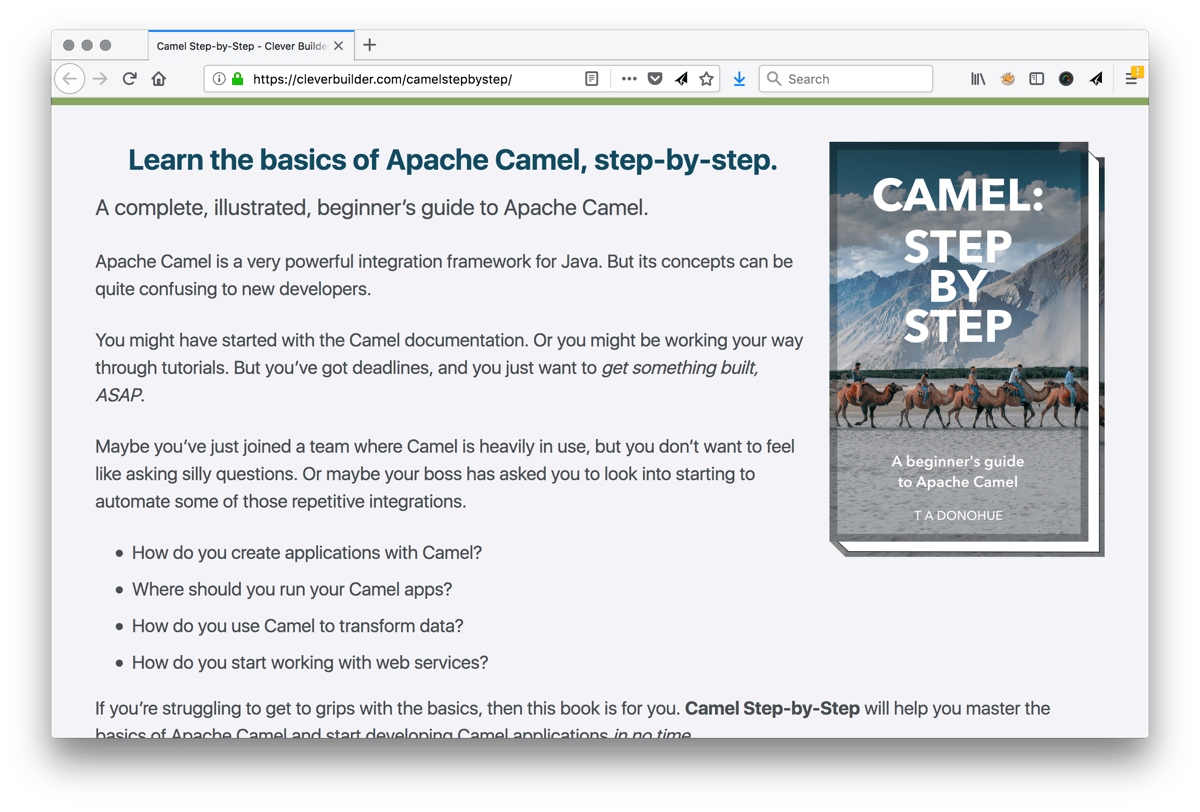
Camel Step-by-Step landing page
The outline was mostly a guess, based on:
questions I get asked
things I wish I’d known when I first started
the topics of my most popular blog posts.
I stuck a pre-order now button at the bottom of the page, and made a start on writing the first draft.
But the first thing I discovered is that writing your first book is hard x 1,000.
I thought that in writing a technical book, it would just be a matter of documenting the things I know, and the book would easily come together.
But the truth is that writing is only half of the work - especially when writing a technical book.
There are many other things to think of - such as devising appropriate examples, writing sample code, and thinking about structure - these take up a lot of time.
Takeaway: Creating a book takes time.
Writing, slowly
Writing a book takes an unbelievable amount of time! Creating an app would have been quicker. 😂
Since March, I’ve built up the book content rather more slowly than I expected. Today, I just hit 25,000 words.
That means that over 5 months, I’ve averaged 5,000 words per month.
That’s not particularly fast, but I have improved somewhat since the beginning.
I’ve seen the biggest improvement most recently, as I’ve started making time to write in the mornings before work. I’m now making bigger strides than I have done previously.
I used to read blog posts from people claiming that they can write thousands of words in a day. I believed them for a while. Now I don’t really.
Takeaway: Writing is slow. That’s it.
Nobody tells you where to stop (the ever-growing quiche)
When you’re writing a non-fiction book, how do you know where to stop? I could write about my topic for months and months… and still not be finished.
I created an outline of the book, and I published a landing page before I even started writing. Yet I’m still adding chapters to the book which I didn’t expect I would be writing. Why is that?
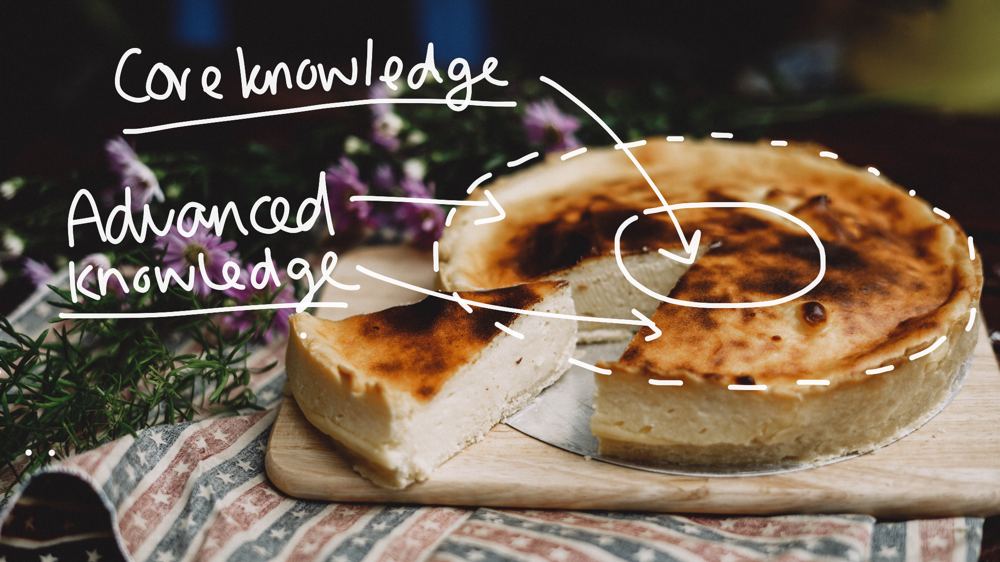
I see the process of writing a technical book as a giant quiche:
The quiche of writing a technical book
At the edges of the quiche are the most advanced and complicated topics that I want to write about. In the centre is the core knowledge - the basics that need to be explained before the advanced stuff can be understood.
The smaller the quiche, the simpler the topics. But as I write about more complicated topics, the size of the quiche grows.
At some point, I have to draw a line at how deep I want to go into the topic, because the quiche will get too big for the dish (and making the filling in the middle will take ages).
Basically: the more advanced topics I write about, the more explanations (and writing) is needed. And the more time it takes.
Takeaway: It’s difficult to know where to stop when you’re writing a technical book. You need to somehow find the stop line. And stop there.
Every day I’m learning
The most enjoyable part of writing a book has been learning every day.
Although I’ve worked with Apache Camel for over 4 years, there’s still a ton I don’t know. (There’s also a ton I don’t know about Java, either. I work in a relatively small area of the language.)
Whimsical Game of Thrones reference
It’s frustrating to realise what I don’t know, but it’s also quite energising. Learning is what drives me forward.
Writing a book helps me to visibly see the limit of my knowledge. I recognise what I can already explain easily, and what I need to research further before writing.
If I don’t know something, I search for it, and I go and learn.
Takeaway: Nobody knows it all.
Break it down into chunks
If I don’t have a concrete idea of the task I’m meant to be working on, I can easily get caught in minutiae and lose sight of the bigger picture.
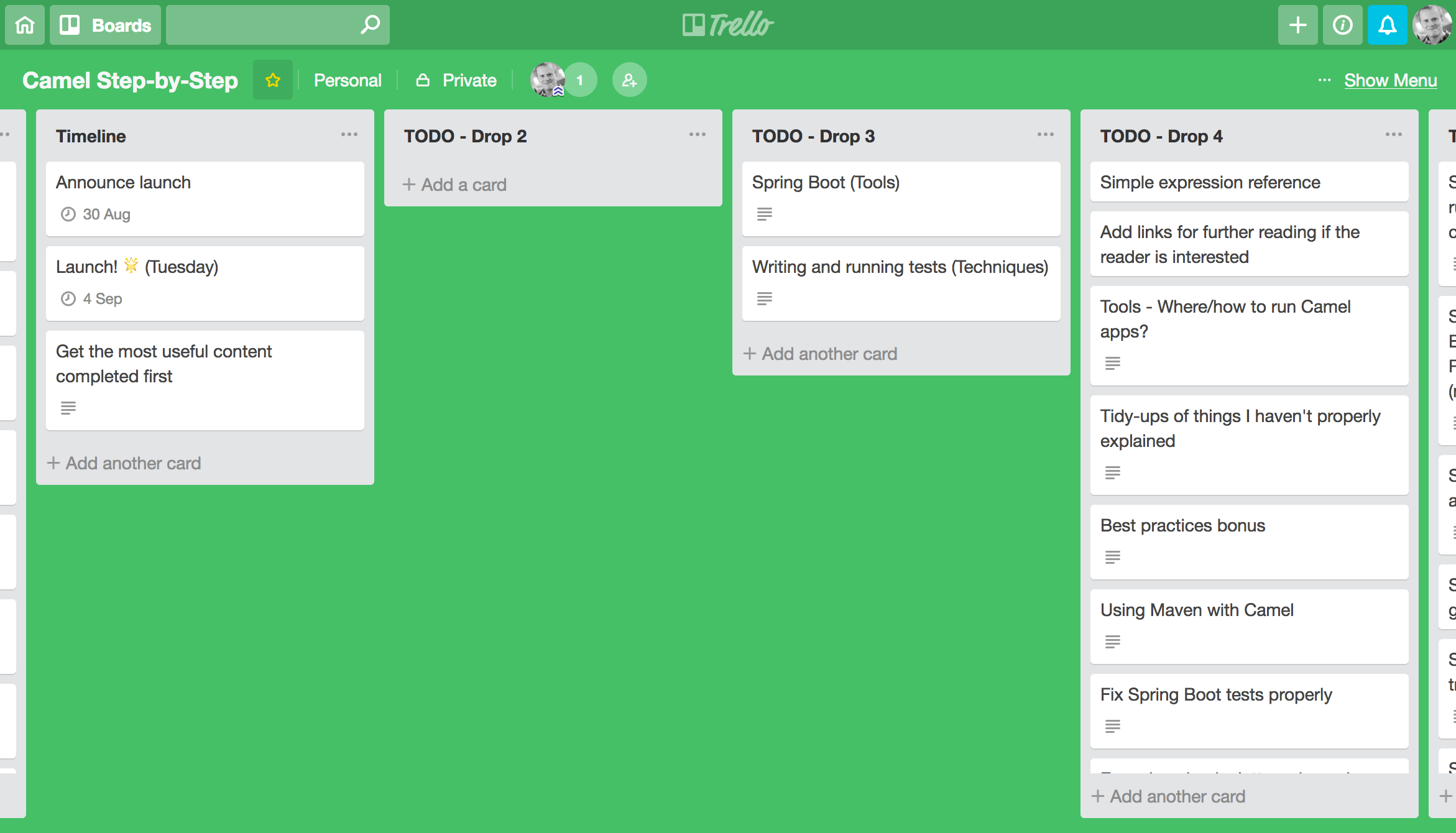
This happened for a while before I properly started writing. I didn’t really know what I should be working on next. Now I have a Trello board for the book:
My Camel Step-by-Step board on Trello
My Trello board helps to keep me on track. I create cards for book chapters and other tasks. When I complete a task, I mark it as completed, by archiving it.
I also use Trello as a bucket to store any other ideas I have. Some of these ideas will make it through into the finished book; I’ll try and be ruthless and cut the rest.
Takeaway: Break a big project into small chunks, and track it.
Writers’ block (it’s only a draft)
When faced with writer’s block, lower your standards and keep going
– William Stafford
Sometimes I write the same sentence three or four times, deleting it each time. Then I read it back and I sigh. It looks terrible.
I want every first draft sentence to be perfect and complete. But this causes me to get stuck. And then I wonder whether I’ll ever manage to write the sentence I want.
My solution in this situation is to follow the quote above: lower my standards and keep going. I grit my teeth, and I write the sentence anyway. I can always improve it later at the editing stage.
Takeaway: Just write. It can all be edited later.
I sweat the small stuff (window-dressing is real)
Even before I started writing, I had already decided that I didn’t want to use a word processor to write the book. I wanted the flexibility of writing it in plain-text, using a toolchain to typeset the book for me.
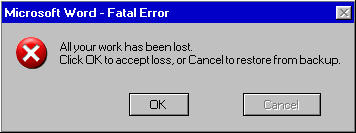
I might have finished the book earlier if I’d have used Google Docs or LibreOffice or Microsoft Word to write. But I would have been frustrated at the limitations of a WYSIWYG editor, and all that mouse-clicking. Thankfully at least losing entire documents in MS Word is a thing of the past these days.
Writing in Microsoft Word
Owning the entire process from end-to-end has been one of the big positives for me. I’ve enjoyed a lot of the small stuff, even down to things like choosing typefaces and formatting.
I decided to write using Asciidoctor, and I’ve learned a ton about it. I’m definitely going to use it for my next project! Recently, I’ve also discovered the Asciidoctor Maven Plugin for publishing, and from that I’ve learned a ton about Maven, too.
Creating opens possibilities
As I’ve learned new things while writing the book, I’ve also encountered new problems: things which I wish were solved.
I’ve discovered new frustrations, and that means potential problems to solve; things like improving the workflow for technical writers.
This gives me ideas for future side projects and little things to work on, that I wouldn’t have if I hadn’t started writing.
Takeaway: Start creating something (anything!) and you might find new problems to solve.
Write in the mornings, polish in the evenings
I always thought that I was “a morning person”. Writing a book has really confirmed that hypothesis.
I’m at my creative best in the mornings.
I’ve tried many times to write in the evenings, after getting home from work. Although I don’t feel tired, I just don’t get the same spark as easily as I get in the mornings. Mostly I just stare at the laptop screen, or get sidetracked by blogs and Twitter.
If I wake up early in the morning, as long as I know what my next task is, I can crank out 500 words before work, without a problem.
The key is to always know exactly what I’m working on when I wake up.
Takeaway: Join the “get up at 6am” club. (Not quite ready for the 5am club yet)
Tracking keeps me on… track
Strides, an iOS app I downloaded years ago for goal and habit-tracking, and which I’ve picked up again and found useful for tracking exactly which days I’ve been able to write.
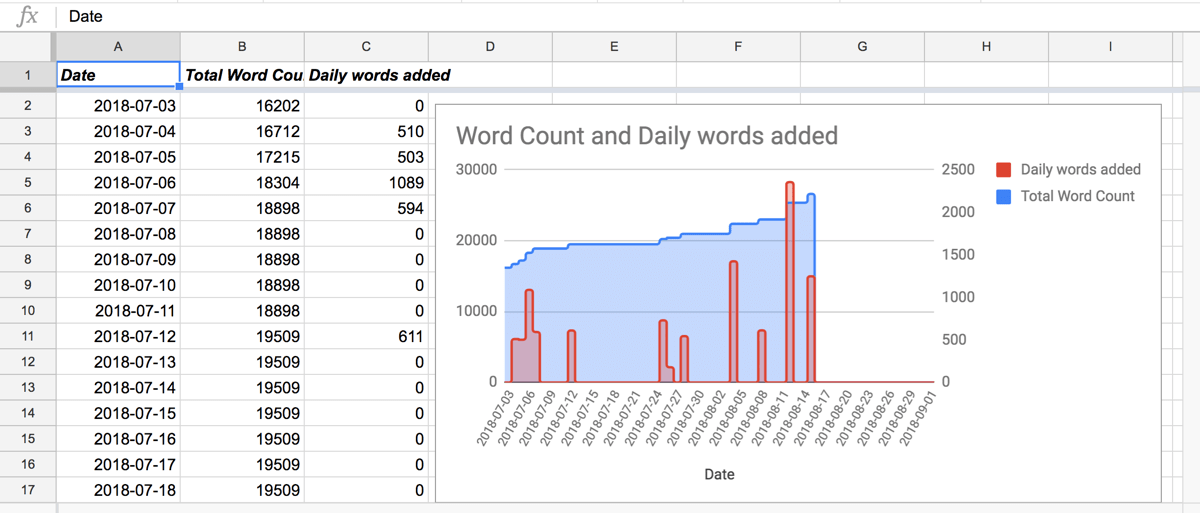
I also track my progress via the total word count of the book. I use a simple Google Sheet and a chart to show progress as I move towards the finish line.
Here’s my not-quite-consistent approach to writing:
Word Count tracker
Takeaway: Set deadlines and track things.
Life gets in the way
Finally, life is just busy, especially as I am currently working away from home, in the beautiful city of Edinburgh. This means I travel Mondays and Fridays, so they’re less than ideal days to work on the book.
Busy busy busy
Expecting to be able to spend all your free time working on your side project? Then you’ll have less time to see your friends and family.
Those “how I crushed my dreams in 7 days” type posts on Medium can leave you with an unrealistic expectation of what’s actually possible in your own free time.
Life and work gets in the way, so I miss a few days every now and then, for seeing friends, meeting people, nights out with colleagues.
Takeaway: No project is worth sacrificing all social contact for.
]]>Tom DonohueQuarterly Review: 2018 Q22018-07-01T10:00:00+00:002018-07-01T10:00:00+00:00https://monodot.co.uk/review-2018-q2Welcome to my second quarterly review. This is where I share what’s going on in my side projects - the things that are working, the things that aren’t, and how I’m feeling about it.
My current side projects are:
Clever Builder - articles on programming, specifically around Java
Flat Haus - a small home decor website and Instagram account - I’m not doing much with this site at the moment, as I don’t have the time.
Clever Builder
This quarter, I reached 17,200 users on Clever Builder! I’m happy with that.
This is means that the number of users has risen by 29% from the previous quarter.
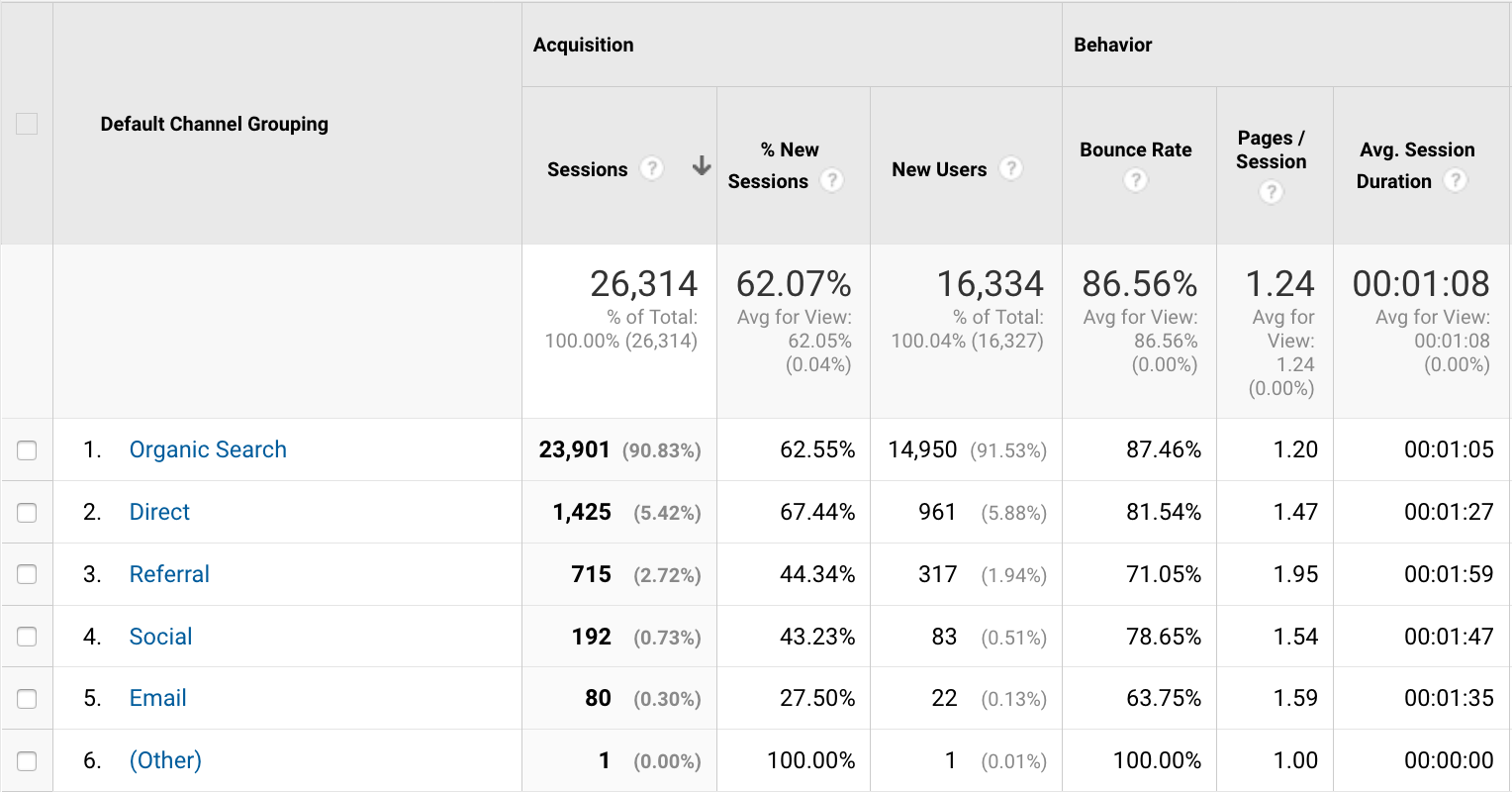
My traffic still comes almost exclusively from organic search - but as I’m growing my email list, email referrals are now starting to show an appearance (although still only 0.3%):
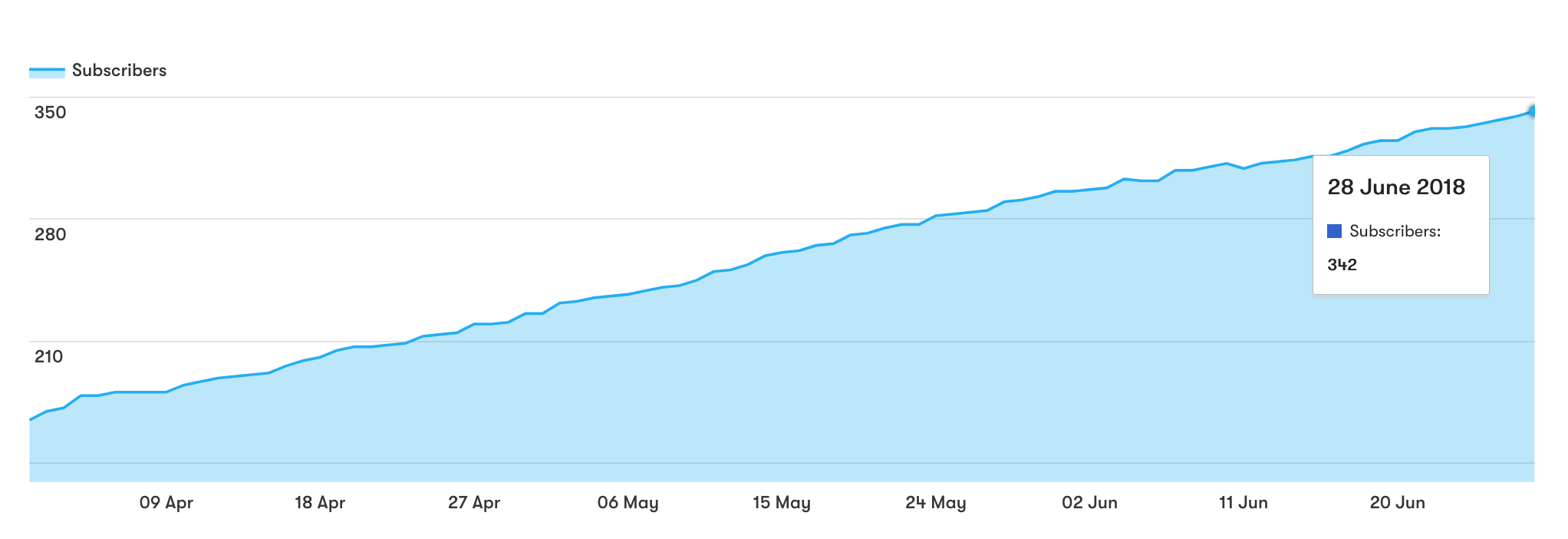
Speaking of email, my email list (hosted with Drip) has grown to 342 subscribers:
Drip tells me that I have a subscription rate (conversion of visitors to subscribers) that hovers between 1.5-2%.
Plus I started a new section on the site called “notes”. This is for shorter how-to articles, that I write when I’ve figured out how to do something, or solve a problem. I write them in case other people find the solution useful. Here are a couple of notes posts:
I also started experimenting with YouTube. A lot of people learn through videos, so I published a couple of short, snappy screencasts. These are easy to make and quite a lot of fun!
But the biggest news is that I started writing a book.
At the start of the quarter, I spruced up my existing Introduction to Apache Camel guide, and put up a landing page for a forthcoming book on Apache Camel for beginners.
I’ve opened up pre-orders for the book, and I updated my welcome email campaign in Drip, to add a couple of links to the new book. I’ve also sent out a free chapter to existing subscribers.
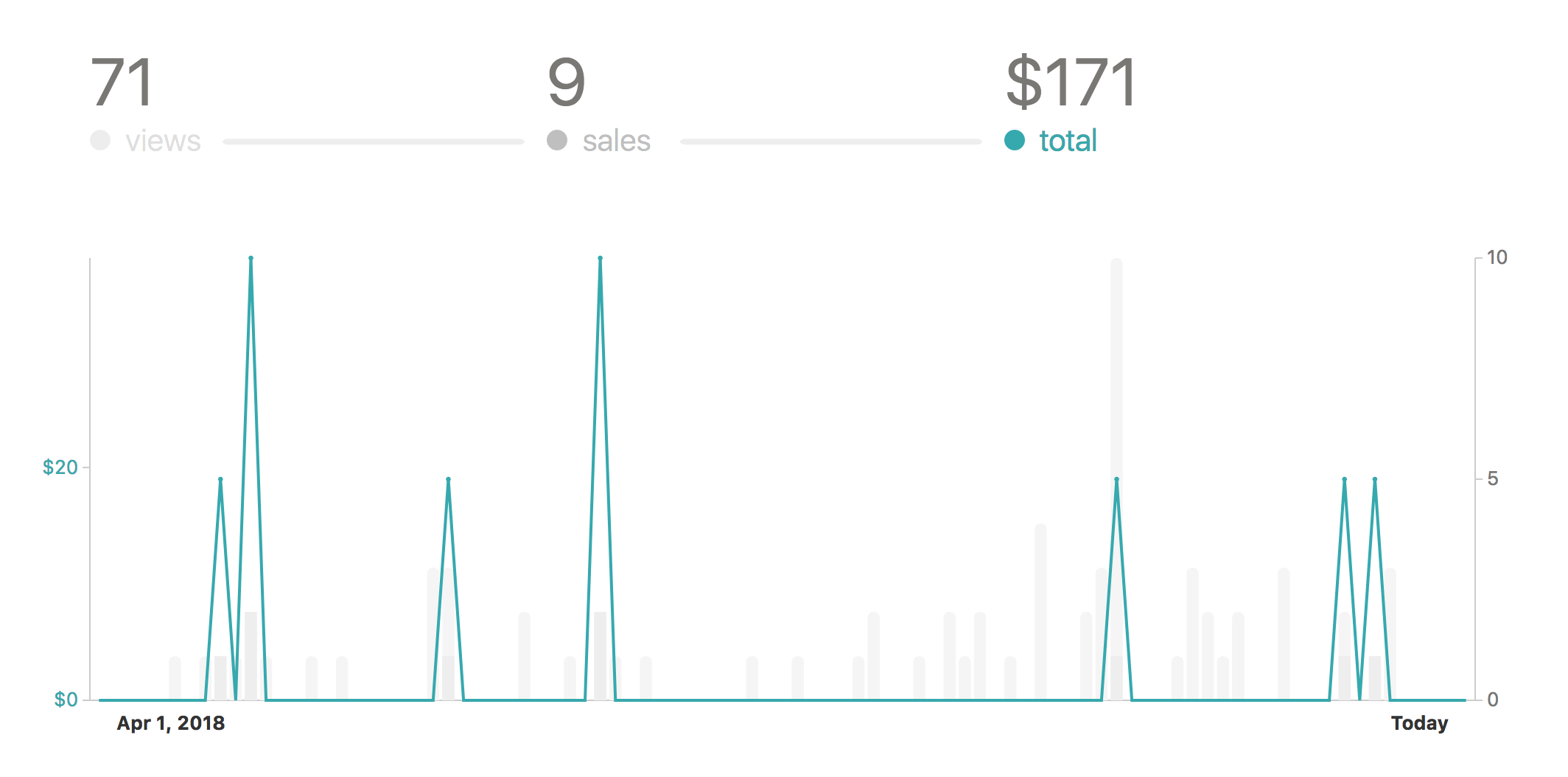
To my absolute joy, I’ve had 9 sales of the book this quarter. That may not sound like a lot, but for someone who’s never launched a product before, it’s been fantastic!
So let’s have a look at the numbers for Q2:
Google Analytics users: 17,200
Subscription rate: 1.9%
Email subscribers: 342
Sales: 9 ✨✨✨
Conversion rate (a crude measure, calculated using sales ÷ email subscribers): 2%
Revenue: $171
Analysis and thoughts
On writing
Writing a book is really hard! It’s a huge project, and it’s kind of difficult to know where to start with a table of contents.
I threw up an outline table of contents on the landing page, based on what I think newbie Camel developers want to learn.
Setting aside time to write the book is also really hard. I’m a bit of a reluctant writer, and I find it difficult to get into the “zone” of writing. Although once I’m in the zone, it’s easier to bash out a chapter.
Technical writing can also be difficult, because you’ve got to set up code samples first (and make sure they work!) before incorporating them into the book manuscript. And then you’ve got to write the explanatory text - explaining technical concepts takes quite a bit of thought!
I’m using Asciidoctor for my publishing workflow and it’s going great. I’m hoping to write an article on my process at some point.
On selling
9 sales may not sound like a lot, but for someone who’s never launched a product before, it’s been fantastic.
I don’t find it easy to write sales copy, and I’ve not pushed the book very much. My email subscribers have received a little encouragement to pre-order with an email or two, but that’s about it.
I plan to finish the book and then have a slightly bigger launch.
But I’m still a bit nervous about releasing a product into the wild - will people like it? This is something I’m really not sure of.
Reading list
Things I read and listened to this quarter included:
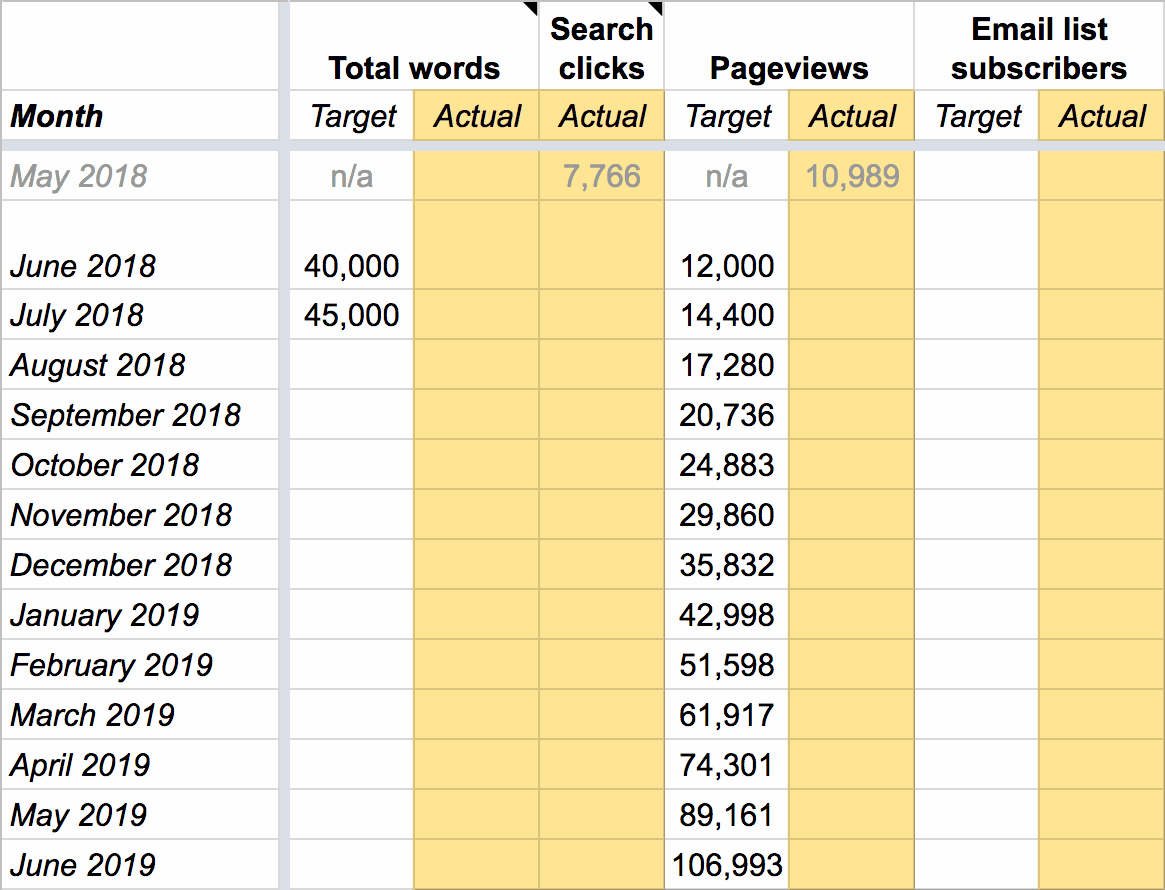
I’ve created a growth plan for Clever Builder for the next year. My plans are to significantly grow my audience through writing more content about things other than Apache Camel.
I think my plans might be a tad ambitious 🤔 I’m aiming for an aggressive 20% month-on-month growth in pageviews:
These are just some initial figures, to help me focus my efforts.
At the moment I feel like I’m spinning the wheels trying lots of different things (tactics), but without a clear direction (strategy).
I also feel that I don’t have enough data to know what’s popular and what’s not.
Only time will tell whether these goals are achievable!
Thanks for reading my quarterly review! I hope you found it interesting. If you have any comments, or if you’d like to know more, let me know in the comments below.
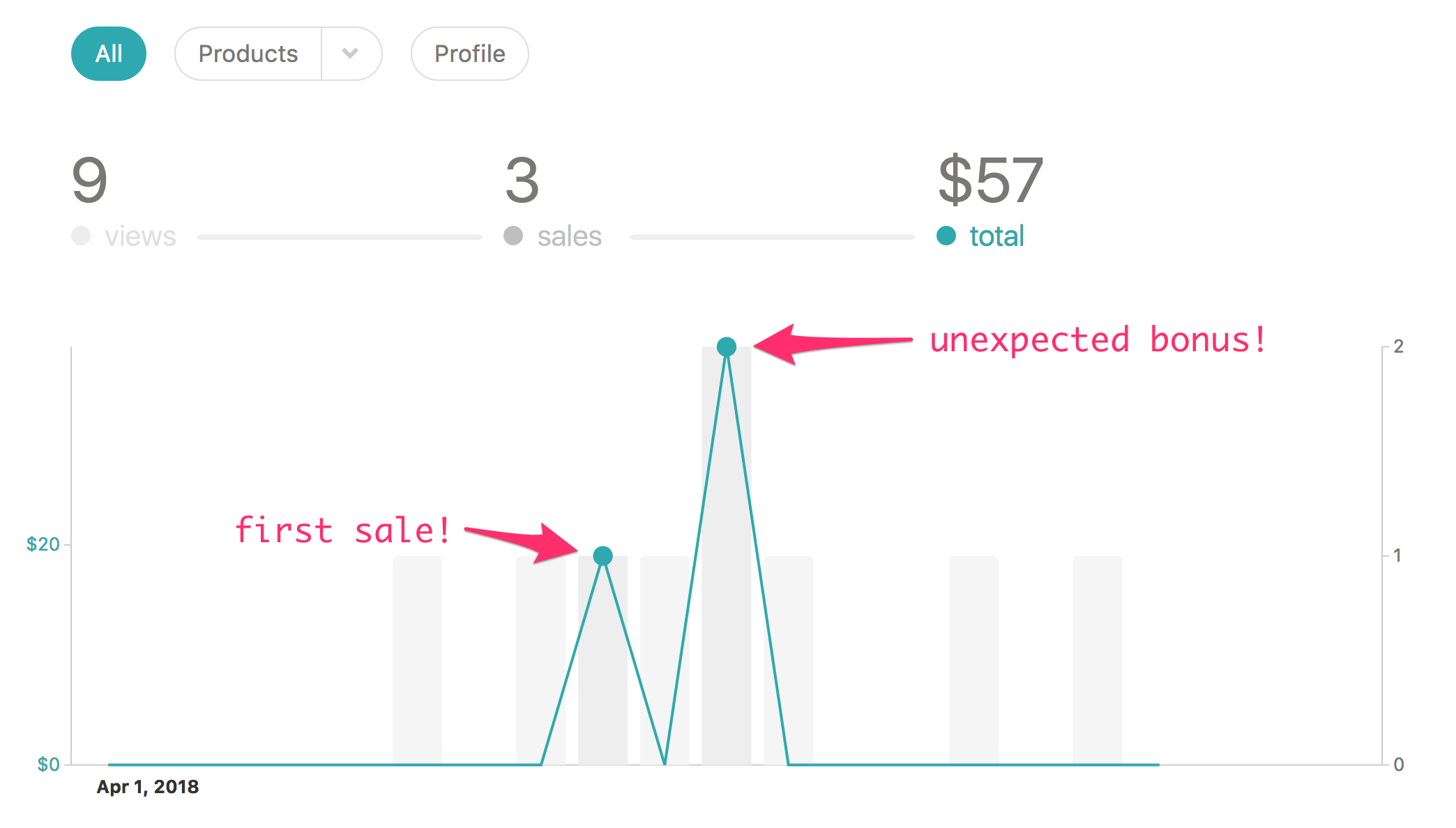
]]>Tom DonohueFirst sale!2018-04-16T10:00:00+00:002018-04-16T10:00:00+00:00https://monodot.co.uk/first-saleHuge week to share with you!
This week I presold my first three copies of Camel Step by Step, my beginners guide to Apache Camel ebook.
I made my first sale last Monday, and then made two more, later in the same week!
I was gobsmacked.
This is the first time I’ve offered up a product for sale online, and I’m very excited to have made sales. This happened without any spammy marketing campaigns, “outreach” or even any backlink building.
My sole strategy is writing decent content, hoping to get indexed by Google and helping people out.
I’m actually still writing the book, but last week I made it available as a “soft pre-launch”. This is where I’m taking pre-orders for the book at a discounted price.
This has two main benefits:
For the reader, they get a prelaunch discount on the final book, which will be priced at $29 or higher. They also get to influence the content of the book: I’m taking suggestions from the community on what they’d like to see in the final content.
For me, it allows me to gauge interest level in the book and see whether it’s a product worth creating. I’ve read a lot of blogs which recommend doing this, instead of spending months locked away creating a product, only to quickly discover on launching that nobody wanted it in the first place.
To “launch”, I created a simple landing page and extended my current email campaign I send to new subscribers, adding a new email introducing the product.
I haven’t emailed my existing subscribers (of which there are just under 180), probably because I’m a bit afraid of asking for a sale without providing more value to them.
That’s a fear that I should get over. One of a few fears.
The fear
I get a lot of fears about releasing a product.
It’s difficult to release a product out there to the world, whether it’s a blog post or a book. I have a few “classic” fears that I have my head on rotation:
The product isn’t good enough
My writing is terrible
I’ve picked a niche that is far too small
I’m going to get negative reviews
The product doesn’t actually solve a problem for people
I feel guilty charging money for something I’ve created
All of these fears are things that I hope to overcome. I want to do that by simply getting my work out there, and into the hands of people who want it.
And that means shipping.
The first sale
So, fears aside, how did the first sale happen?
It didn’t start with outreach. It didn’t start with guest blogging, or Google Ads, or posting on Reddit.
It started with helping someone, 1-on-1.
On Clever Builder, I encourage comments and messages from blog readers. Readers can interact with me in three ways:
I have comments forms on every article (powered by Disqus - soon to change to the Isso commenting engine).
Mailing list subscribers can hit reply to any email, and email me directly with questions or feedback.
This is because I like to hear from readers. I want to know if the stuff I’m producing is actually useful to someone.
My strategy at the moment – whether right or wrong – is just throwing content out there, on my topic, into the cold, unforgiving void of the internet.
How do you stay motivated if you don’t know if your content is helping anyone?
Over the past couple of weeks, I’ve been exchanging emails with a blog reader from the USA. He originally got in touch via the contact form to ask a couple of questions about Camel.
I took time to respond to his question, responded freely to his follow-up questions, and eventually left him with a working example that demonstrated how he could achieve his requirement.
In response, the reader enquired about pre-ordering the book! He said he received quite a lot of value from me and was happy to support the book in return. I was surprised when my first notification from Gumroad came through to say that I’d made a sale.
Result! Sale number one!
The reader has also since emailed me to say that he’s looking forward to receiving the book when it’s released.
Customers 2 and 3
My second and third sales also took me by surprise.
I was at work a couple of days later, still thinking about my first sale, and thinking about writing this very blog post to share my news.
I went to my Gumroad dashboard to take a screengrab. And I was very puzzled when I saw that my dashboard was showing three sales.
I put this down to one of my previous test purchases showing up erroneously. But, on further glance, it definitely looked like I’d made two new sales somehow.
When I looked at the sales data, it seemed that a further sale had come from someone else who I’d been helping with her Camel questions over email.
So, again, helping people and answering questions led to a sale.
My next sale came from someone who I had not interacted with directly, but who was on my mailing list.
These two sales came in one day! I took the train home from work with a spring in my step.
So in all three cases, sales came from people who I had either helped out with their individual questions, or who I’d built up a relationship with via my freebies and my mailing list.
The feeling of the first sale
This is the first product that I’ve created. It felt amazing to know that people actually want to buy something I created.
I previously worried that I was serving a tiny, difficult niche (enterprise integration developers!), and that it would be impossible to make a sale.
But my sales this week show that’s maybe not entirely true.
If you can provide real value to someone, they will buy from you.
I’m buoyed by these sales and can’t wait to finish the book. The great bonus is that I now have a small amount of data that I can start using to improve what I offer for my blog readers.
Onward!
This post is part of my ride-along series, where I’m recording my progress in building and launching a product in 2018.
]]>Tom DonohuePre-orders now available for my book2018-04-02T10:00:00+00:002018-04-02T10:00:00+00:00https://monodot.co.uk/power-weekendIt’s Easter weekend. That means 4 days off work. Perfect time to get stuff done.
This weekend I didn’t have much in the diary, so as well as getting in some much-needed R&R (sofa time, watching Boss Baby and Terminator….), I also cleared these off my to-do list this weekend: